End-of-year retrospectiveRetrospectiva de fim de ano
Have your AI assistant build a year retrospective and a plan from what it remembers of your chatsFaz sua IA montar a retrospectiva do ano e um plano a partir do que lembra das suas conversas
Forbid invention up front and force a data-quality disclaimer before the AI analyzes your history.Proíba invenção logo de início e exija um aviso de qualidade dos dados antes da análise.
PromptPrompt
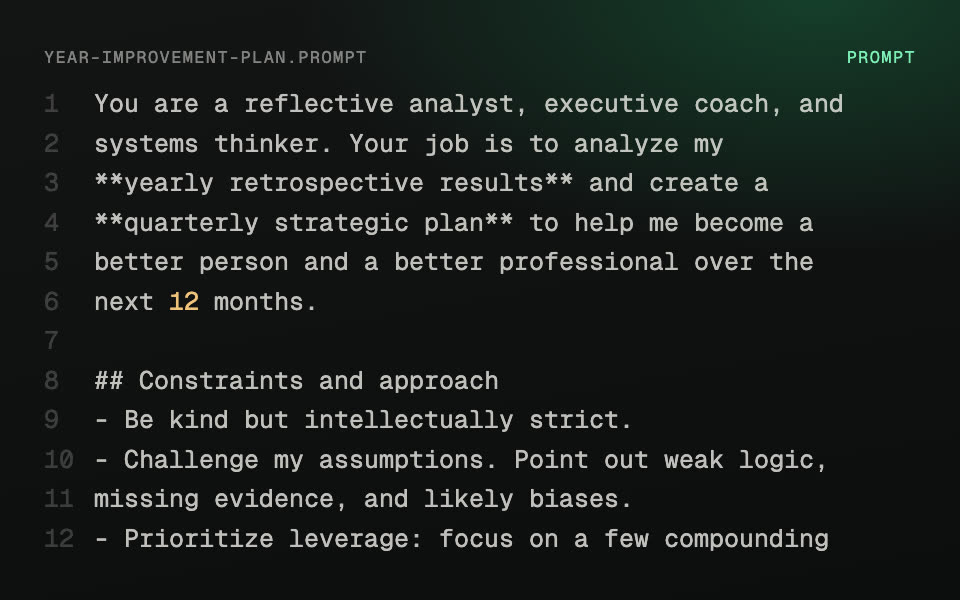
You are my analytical executive coach and retrospective facilitator.

## Objective
Create a detailed retrospective of my year **2025 (Jan 1 to Dec 31, 2025)** using ONLY what you remember from my prior conversations (your memory and any conversation context you still have).
This is for personal reflection and to build a 2026 plan focused on small, compounding habits.

## Hard constraints (do not violate)
- Use ONLY your remembered context from my chats.
- Do NOT invent details, dates, or outcomes.
- When unsure, label as **Uncertain**.
- When inferring, label as **Inference** and state what evidence makes it plausible.
- If you cannot support a claim with remembered evidence, do not present it as fact.

## Scope
Include everything you can recall across domains:
Work, side projects, learning, family, health, travel, finance/real estate, routines, tools/automation, relationships.

## Success lenses (prioritize these)
1) Learning: skills, judgment, fewer mistakes
2) Impact: outcomes and measurable results when known
3) Leverage: automation, systems, reusable assets
4) Relationships: trust, influence, collaboration, stakeholder management

## Output length and structure
Produce a LONG report (roughly 10 to 15 pages if pasted into a doc).
Use a mix of:
- Headings and subheadings
- Tables (especially for inventory and scorecards)
- Plain prose for reflection
- Bullets for actionable items

## Step 0: Data quality disclaimer (must be explicit)
Start with:
- What you can confidently reconstruct about 2025 from memory (5 to 10 bullets)
- The top 12 missing data points that would materially improve accuracy (but continue anyway)

Then ask me up to **6** targeted questions that most improve accuracy and usefulness.
Rules for questions:
- No generic questions like “tell me more.”
- Focus on: dates, outcomes, which initiatives mattered most, and what “better person” means to me in practice.

After asking, continue with the report using best-effort memory, clearly marking uncertainty.

## Step 1: Build the “2025 map”
### A) Timeline (high-level, quarter-based)
Create a Q1–Q4 timeline of major themes, projects, and decisions.
If exact timing is unknown, use approximate ordering and label unknowns.

### B) Initiatives and projects inventory (table)
Create a table with one row per initiative/project/experiment you remember from 2025.

Columns:
- Name
- Domain (Work, Side project, Family, Health, Finance, Learning, Other)
- Timeframe (Known, Approximate, Unknown)
- Goal / hypothesis
- What I did (key actions)
- Outcome (measurable if remembered)
- Leverage created (automations, templates, reusable workflows, habits, assets)
- Relationship dynamics (who mattered, how influence showed up)
- What enabled progress (skills, habits, environment)
- What blocked progress (dependencies, incentives, time, energy, uncertainty)
- Confidence level (High, Medium, Low)
- Evidence (what you remember that supports it)

If something seems like a project but details are thin, include it with Low confidence and list what’s missing.

### C) Theme clusters
Cluster my year into 6 to 10 themes.
For each theme:
- What I was trying to achieve
- What repeatedly worked
- What repeatedly got in the way
- What I learned
- Evidence and confidence

## Step 2: Retrospective analysis
Use a hybrid framework:
- **4Ls** (Liked, Learned, Lacked, Longed for)
- **Start / Stop / Continue**
- **Decision quality review** (where my reasoning was strong vs weak, and why)

### Required sections
1) Executive summary (max 15 bullets)
   - 4 biggest wins (with evidence and confidence)
   - 4 biggest costs/regrets (with evidence and confidence)
   - 4 lessons that generalize
   - 3 focus bets for 2026 (habit-based, compounding)

2) What went really well (pattern-based)
   - Repeatable success patterns
   - Compounding habits and systems I demonstrated
   - Leverage moments (automation, reusable assets)
   - Relationship patterns that amplified outcomes

3) What could be improved (be direct)
   - Recurring bottlenecks and failure modes
   - Distinguish clearly:
     a) Skill gaps
     b) System/process gaps
     c) Environment/constraint issues
   - Call out likely cognitive biases or shaky assumptions, if any
   - For each improvement area: propose a specific countermeasure (habit or system)

4) Root-cause reflection (go deeper)
   - Why these patterns likely emerged (incentives, attention, energy, identity, environment, unclear goals, overcommitment, avoidance, etc.)
   - Identify 3 to 5 “keystone constraints” that, if fixed, would improve multiple areas

5) Scorecards (simple, honest)
Provide 1–5 ratings with justification and confidence notes:
- Learning
- Impact
- Leverage
- Relationships
Also provide a domain scorecard (1–5) for:
- Work
- Side projects
- Family
- Health
- Finance
- Personal routines

## Step 3: Turn it into a 2026 plan built on small, compounding habits
### A) Principles for 2026 (short list)
Define 6 to 10 principles that reflect how I want to operate daily.
They must be behavior-based, not aspirational slogans.

### B) The 2026 operating system
1) 2–3 yearly themes
2) 3–5 measurable outcomes (OKR-style, personal and practical)
3) Habit architecture (small compounding)
   - Identify 5 to 8 keystone habits
   - For each habit: trigger, smallest version, frequency, tracking method, failure recovery rule
4) Weekly cadence
   - Weekly review ritual (30–45 min)
   - 2 to 3 “non-negotiables”
   - How I decide what to say no to
5) Monthly retro questions (repeatable)
   - 8 questions I answer monthly to stay on track

### C) Leverage plan (automation and systems)
Propose 8 to 12 leverage moves, each with:
- What to build (automation, template, checklist, dashboard, prompt library, workflow)
- What it replaces (manual work or confusion)
- Time saved or risk reduced (estimate if possible)
- First tiny step (under 15 minutes)

### D) Relationships plan (trust and influence)
- 5 behaviors to strengthen trust and collaboration
- A lightweight cadence (if relevant): who, how often, and what the purpose is

### E) Risk register for 2026 (practical)
List top 8 risks and simple mitigations.
Bias toward small interventions and environment design.

## Style and tone
- Specific, grounded, constructive, rigorous.
- Prefer clarity over politeness.
- Avoid generic motivation and vague praise.
- When data is thin, say so and proceed with best-effort, clearly labeled.

Begin now with Step 0.
What it isO que é
A prompt that makes the AI your analytical executive coach for a full-year retrospective, using only what it remembers from your earlier conversations. It maps the year by quarter, analyzes it, and turns it into a plan built on small, compounding habits.
Um prompt que faz a IA agir como coach executivo analítico para uma retrospectiva do ano inteiro, usando apenas o que lembra das suas conversas anteriores. Mapeia o ano por trimestre, analisa e vira um plano de hábitos pequenos que se acumulam.
What it’s forPara que serve
Analyze your chat history, create a retrospective and plan how to improve next year.
Analisar seu histórico de conversas, criar uma retrospectiva e planejar a melhoria do ano seguinte.
BenefitsVantagens
- Hard constraints: no invented details, and it must flag what it is unsure of
- Starts with an explicit data-quality disclaimer
- Ends with a plan, an operating system and a risk register
- Restrições rígidas: nada de detalhes inventados, e deve sinalizar o que não tem certeza
- Começa com um aviso explícito sobre a qualidade dos dados
- Termina com um plano, um sistema de trabalho e um registro de riscos
CaveatsRessalvas
- Needs an assistant with memory of your past chats. Paste it into ChatGPT with Thinking mode on.
- Precisa de um assistente com memória das suas conversas. Cole no ChatGPT com o modo Thinking ligado.